
Blogs

Read expert insights on current affairs in healthcare!

The Future of Elder Care: Can Kerala’s Community-Based Care Model Become a Universal Standard?

When the Indian state of Kerala established a dedicated Department for Elderly Welfare in May 2026, many viewed the move as little more than a regional administrative reform. Yet behind this decision lies a far more significant message: population ageing is no longer merely a matter of social welfare—it is a question of how societies are organised.Kerala has the highest proportion of residents aged 60 and over among India’s states. At the same time, decades of migration to other parts of India, the Middle East and Europe have left many older adults without the day-to-day support of their families. In response, the state is seeking to develop a model that enables people to remain in their own homes and communities, rather than being forced into institutional care.

The demographic trends shaping Kerala today are already evident across much of Europe, East Asia and an increasing number of countries in the Global South. People are living longer, having fewer children and moving more frequently for education and employment. The result is not only a growing older population, but also an increasing geographical distance between generations. The traditional model of care, in which adult children provide daily support for their ageing parents, is becoming increasingly difficult to sustain. Financial assistance can be transferred digitally, but help after a fall, transportation to a medical appointment or simply regular human companionship cannot always be provided from a distance.
This is why Kerala is attempting to integrate healthcare, social services, local government and community support into a single coordinated system. Such an approach is closely aligned with the direction promoted by the World Health Organization through its Decade of Healthy Ageing 2021–2030 initiative, which emphasises age-friendly communities, integrated care and accessible long-term support. This approach is further reflected in the WHO’s Integrated Care for Older People (ICOPE) framework, which promotes person-centred, community-based care designed around maintaining functional ability rather than treating diseases in isolation.
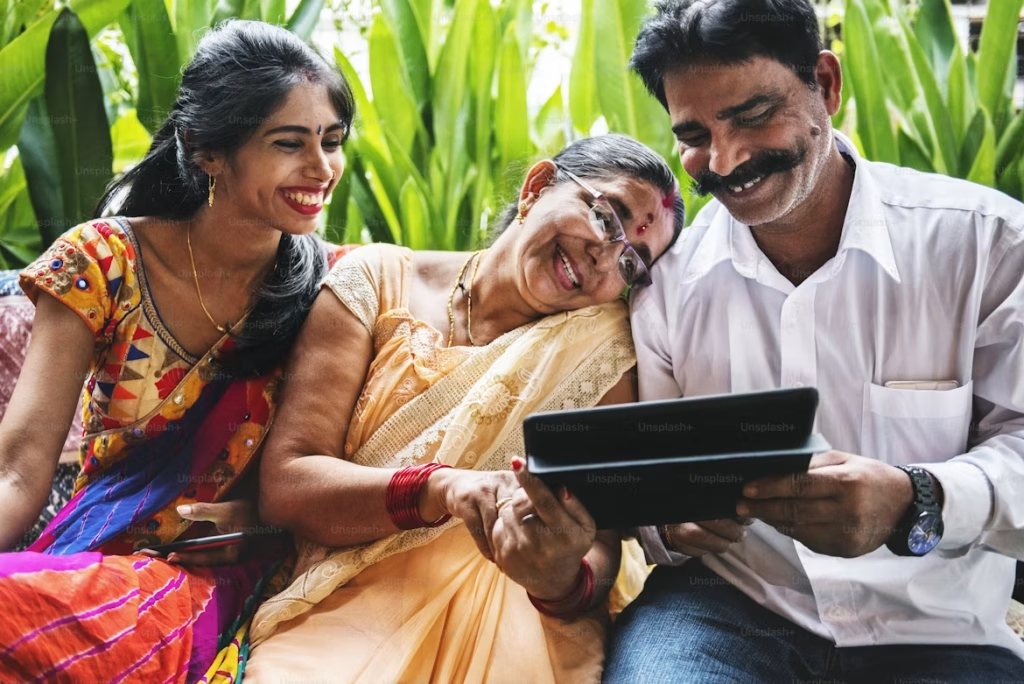
From Institutional Care to Ageing in the Community

Perhaps the most remarkable aspect of Kerala’s reform is not the creation of a new government department, but a shift in philosophy. Rather than viewing older people as individuals who will inevitably require institutional care, the reform embraces the concept of ageing in place—enabling people to continue living in familiar surroundings for as long as possible.
This approach includes home-based care, day-care centres, social participation programmes, volunteer networks, caregiver training and digital tools that improve the coordination of support. Beyond reflecting the preferences of most older adults, such a model may also contribute to a more sustainable organisation of long-term care.
The international framework for this approach has existed for decades. The United Nations Principles for Older Persons identify independence, participation, care, self-fulfilment and dignity as the core values that should guide policies for older people. Kerala is therefore not creating new rights for older adults; rather, it seeks to translate long-established international principles into a practical institutional model of care. These principles were further reinforced in the Madrid International Plan of Action on Ageing, which encouraged governments to integrate ageing into broader social and economic development policies.

What Should a Universal Model of Elder Care Include?

Kerala’s experience demonstrates that an effective elder care system cannot rely on a single institution. Instead, it requires the integration of healthcare, social services and community support into one coordinated network. The objective is not simply to provide medical or social assistance, but to enable older people to maintain their independence, dignity and quality of life within their own communities for as long as possible.
At the heart of such a model should be the right to remain at home whenever this is both possible and safe, with institutional care serving as a last rather than a first resort. Achieving this requires investment in home-based services, better integration between healthcare and social care, and coordinated support tailored to each individual’s needs, regardless of which sector delivers it.
Community support plays an equally important role. Volunteer networks, neighbourhood initiatives and social participation programmes can reduce loneliness and social isolation, while investment in a well-trained professional caregiving workforce helps ensure the quality and sustainability of long-term care. At the same time, digital technologies can improve safety and facilitate care coordination, but they should complement—not replace—human interaction and a sense of belonging within the community.
Taken together, these elements demonstrate that elder care is far more than a matter of healthcare or social policy. It is about creating a system that enables people to age with dignity while responding effectively to the demographic realities of contemporary society.

Lessons for Europe

For years, European countries have focused their debates on the sustainability of pension systems, rising healthcare expenditure and the financing of long-term care. Far less attention has been paid to a simpler but equally important question: who will actually be there when an older person needs help? Kerala’s experience suggests that the quality of elder care depends not only on the level of public spending or the capacity of health and social care systems, but also on the existence of well-organised community support capable of responding quickly to people’s everyday needs. Strengthening local communities and improving coordination between services may therefore prove just as important as increasing financial resources.
This lesson is particularly relevant for European countries experiencing sustained emigration of younger generations alongside rapid population ageing. Croatia, Portugal, Romania and many other countries are already facing the consequences of adult children living and working in different cities or abroad while their ageing parents remain at home. Under these circumstances, public policy can no longer assume that families will always provide the primary source of care. Instead, governments need to recognise this new demographic reality and develop systems that complement family support with accessible community-based services, rather than taking family care for granted.
The same direction can be seen in the European Pillar of Social Rights, which recognises access to affordable long-term care as one of the foundations of social protection in ageing societies.

Conclusion

Kerala is unlikely to become a perfect model overnight. Funding constraints, workforce shortages and effective coordination across institutions remain significant challenges. Nevertheless, the true value of this initiative lies not only in the programmes it introduces, but in the question it asks.
Instead of asking, “How do we accommodate a growing number of older people?”, Kerala asks, “How do we organise society so that people can age with dignity, remain connected to their communities and continue living safely?”
This is a question that almost every country will have to confront in the coming decades. For that reason, Kerala’s reform is far more than a regional policy initiative—it offers an important indication of the direction in which long-term care systems will need to evolve as societies continue to age.

Share Your Opinion, Publication, or other Engagement!

Share Your Opinion, Publication, or other Engagement!

OUR NEWSLETTER

© 2026 New Healthcare d.o.o. All Rights Reserved.